

Microsoft 365 Researcher Gets Smarter with Critique and Model Council
Introduction
Research is rarely about simply finding information. Good research requires collecting information from multiple sources, evaluating whether those sources are trustworthy, identifying gaps, comparing different viewpoints, and finally turning everything into a useful conclusion.
Microsoft 365 Copilot’s Researcher agent is designed for these deeper research scenarios. Instead of providing a quick conversational answer, Researcher can gather information from the web and organizational work content, analyze it, and produce a structured research report.
Microsoft has taken this capability further by introducing a multi-model approach to Researcher. Rather than relying on a single AI model for every stage of research, Researcher can work with models from both OpenAI (GPT) and Anthropic (Claude).
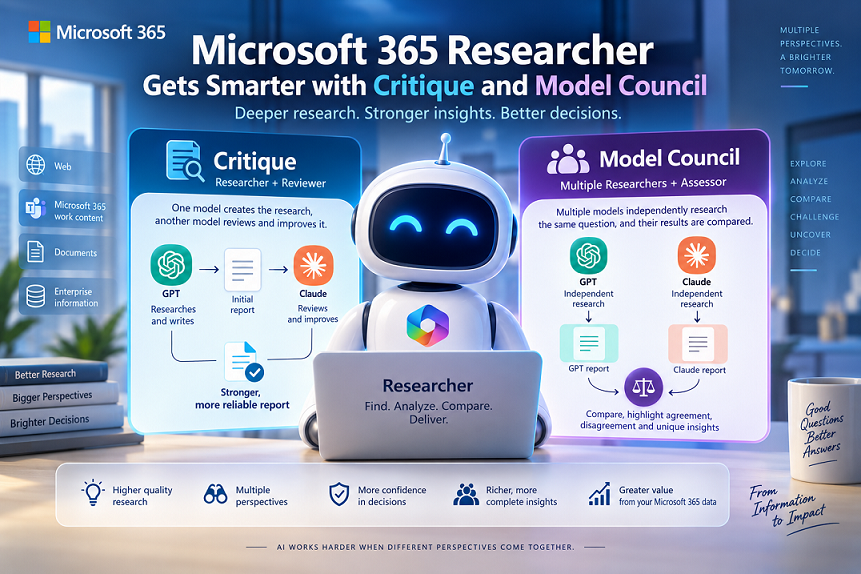
Two particularly interesting capabilities emerge from this approach:
-
Critique: One model creates the research, while another model reviews and improves it.
-
Model Council: Multiple models independently research the same question, and Researcher compares their findings.
A simple way to remember the difference is:
Critique = Researcher + Reviewer
Council = Multiple Researchers + Assessor
These modes address two different problems. Critique focuses primarily on improving the quality of one research report, while Council focuses on giving you multiple perspectives before making a decision.
Let’s explore both in detail.
What is Microsoft 365 Researcher?
Researcher is a deep research agent available within Microsoft 365 Copilot. It is intended for tasks that require more investigation and reasoning than a normal Copilot conversation.
Instead of immediately generating an answer, Researcher can work through a research process that involves gathering information, analyzing sources, connecting findings, and producing a structured report.
Researcher can work with information from:
- The web
- Microsoft 365 work content available to the user
- Documents and other relevant enterprise information
- Multiple AI models depending on the selected Researcher mode
This makes it useful for scenarios such as:
- Competitive analysis
- Market research
- Technology evaluation
- Product research
- Regulatory research
- Business strategy
- Vendor comparison
- Preparing executive reports
- Investigating emerging technologies
- Comparing different approaches to a problem
For example, instead of asking Copilot:
What is Agentic AI?
you could ask Researcher:
Research the current state of Agentic AI in enterprises. Explain the major technology approaches, leading platforms, adoption challenges, security considerations, and likely developments over the next two years. Provide recommendations for an enterprise evaluating Agentic AI.
The second question requires significantly more investigation, analysis, and synthesis. This is where Researcher becomes particularly useful.
Model Choice in Researcher
Researcher supports multiple model options. Depending on the features enabled for your organization, the model picker can provide options such as:
| Option | What happens |
|---|---|
| Auto / Critique | GPT generates the research and Claude provides another reasoning/review pass |
| Model Council | GPT and Claude independently research the same question and their results are compared |
| GPT | Research is performed using the GPT model |
| Claude | Research is performed using the Claude model |
The interesting change here is that model selection is no longer simply about asking: “Which AI model is better?” Instead, Microsoft can use the different models together. That leads us to Critique and Council.
Critique Mode
What is Critique?
Critique introduces a review stage into AI-generated research. A useful analogy is writing an important technical article. You might have one person research and write the article. Before publishing it, another experienced person reviews the article and asks:
- Are the conclusions supported by evidence?
- Are important points missing?
- Are the sources reliable?
- Is the argument structured correctly?
- Did the author misunderstand anything?
- Are there claims that need stronger evidence?
Critique applies a similar idea to AI research. Rather than allowing one AI model to research, reason, write, and effectively approve its own work, another model participates in evaluating the result.
How Critique Works
At a high level, the process looks like this:
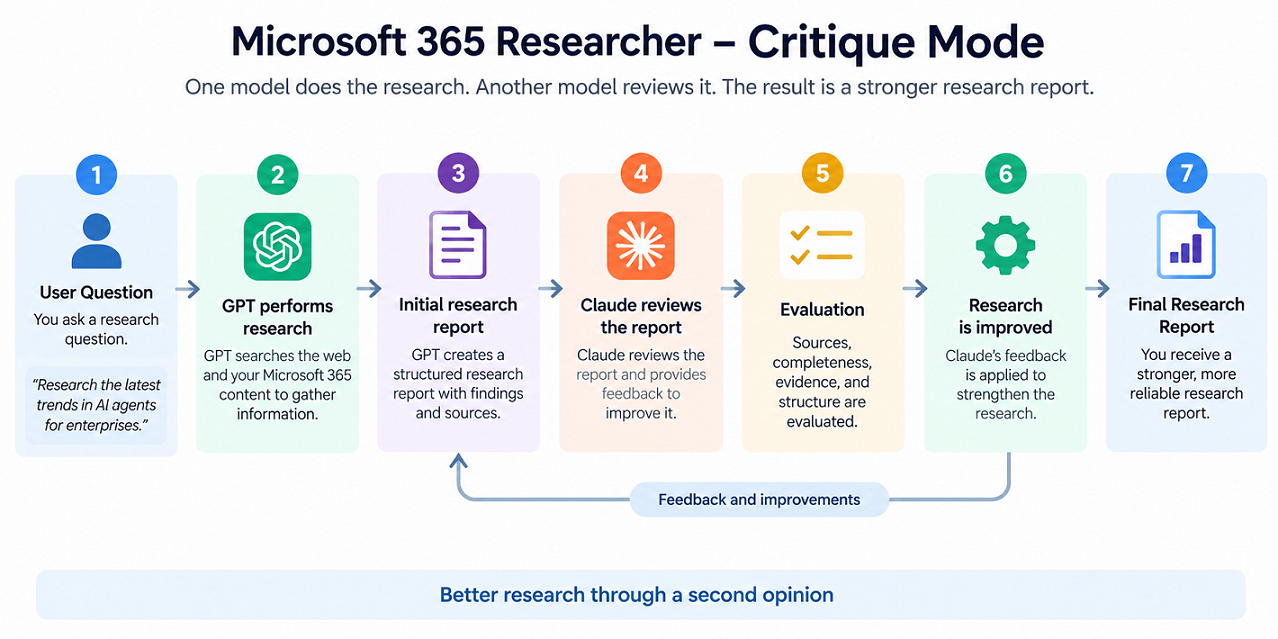
The important point is that the second model isn’t simply being asked to rewrite the first model’s answer. It acts more like an independent reviewer. This separation between generation and evaluation is what makes Critique interesting.
What Does Critique Review?
1. Source Quality
Not every source found on the internet has the same authority.
For example, imagine Researcher is investigating:
What are the security implications of implementing generative AI within financial services?
The initial research could find information from government regulators, Microsoft documentation, research institutions, security companies, technology blogs, news articles, and community discussions.
Critique helps prioritize reputable and appropriate sources rather than treating every source equally.
2. Completeness
A report can be factually correct but still incomplete.
Suppose you ask:
Compare Microsoft Copilot Studio and Azure AI Foundry for building enterprise AI agents.
A report might provide an excellent comparison of development capabilities but completely miss governance, authentication, deployment, monitoring, licensing, integration, target personas, or enterprise architecture.
The reviewer can evaluate whether the original research actually answered the full intent of the question.
3. Evidence Grounding
One of the biggest challenges with generative AI is producing statements that sound reasonable but are insufficiently supported.
Critique provides another reasoning pass over the report. It can examine whether important statements are supported by the research and whether the evidence used is appropriate.
This is particularly valuable for reports that will eventually be shared with customers, executives, architects, decision makers, compliance teams, and management.
4. Structure
Good information can still produce a bad report if it isn’t organized properly.
The review stage can help improve how the findings are presented.
For example, instead of presenting dozens of unrelated observations, the final report might organize them into:
Current landscape → Options → Benefits → Risks → Comparison → Recommendation
That makes the research much more actionable.
Example: Using Critique for Technology Evaluation
Imagine that an enterprise wants to determine whether it should build an AI solution using Microsoft Copilot Studio or Microsoft Foundry.
A suitable Researcher prompt could be:
Research Microsoft Copilot Studio and Microsoft Foundry as platforms for developing enterprise AI agents. Compare their architecture, development experience, extensibility, knowledge integration, authentication, governance, monitoring, deployment, licensing considerations, and suitable enterprise scenarios. Identify the strengths and limitations of each platform and provide recommendations for when an organization should use each approach.
With Critique, think of the process as two roles.
Researcher
The first model investigates the subject and creates the report.
It might determine that Copilot Studio provides a low-code experience, Foundry offers greater control for custom AI engineering, both support enterprise agent scenarios, their governance and deployment approaches differ, and different development teams may prefer different platforms.
Reviewer
The second model then evaluates that work.
It might effectively challenge the report:
The architecture comparison is strong, but the report doesn’t sufficiently explain identity and authentication.
Or:
The recommendation doesn’t clearly differentiate scenarios where professional developers require custom orchestration.
Or:
Some conclusions need stronger supporting evidence.
The resulting report can therefore be more complete than simply accepting the initial research output.
When Should You Use Critique?
Critique is particularly suitable when you ultimately need one strong report.
Typical scenarios include:
- Customer research
- Competitive analysis
- Technical architecture research
- Regulatory summaries
- Product comparisons
- Vendor evaluations
- Executive briefing documents
- Technology recommendations
- Market analysis
Think of Critique as:
“Research this carefully, review your work, and give me the strongest final report.”
Model Council
Critique tries to improve one research output.
Model Council takes a fundamentally different approach.
Instead of one model creating the research and another reviewing it, Council asks multiple models to independently investigate the same question.
In the current Researcher experience, this means deep-reasoning models such as GPT and Claude can work on the same research problem in parallel.
How Model Council Works
Conceptually, the process looks like this:
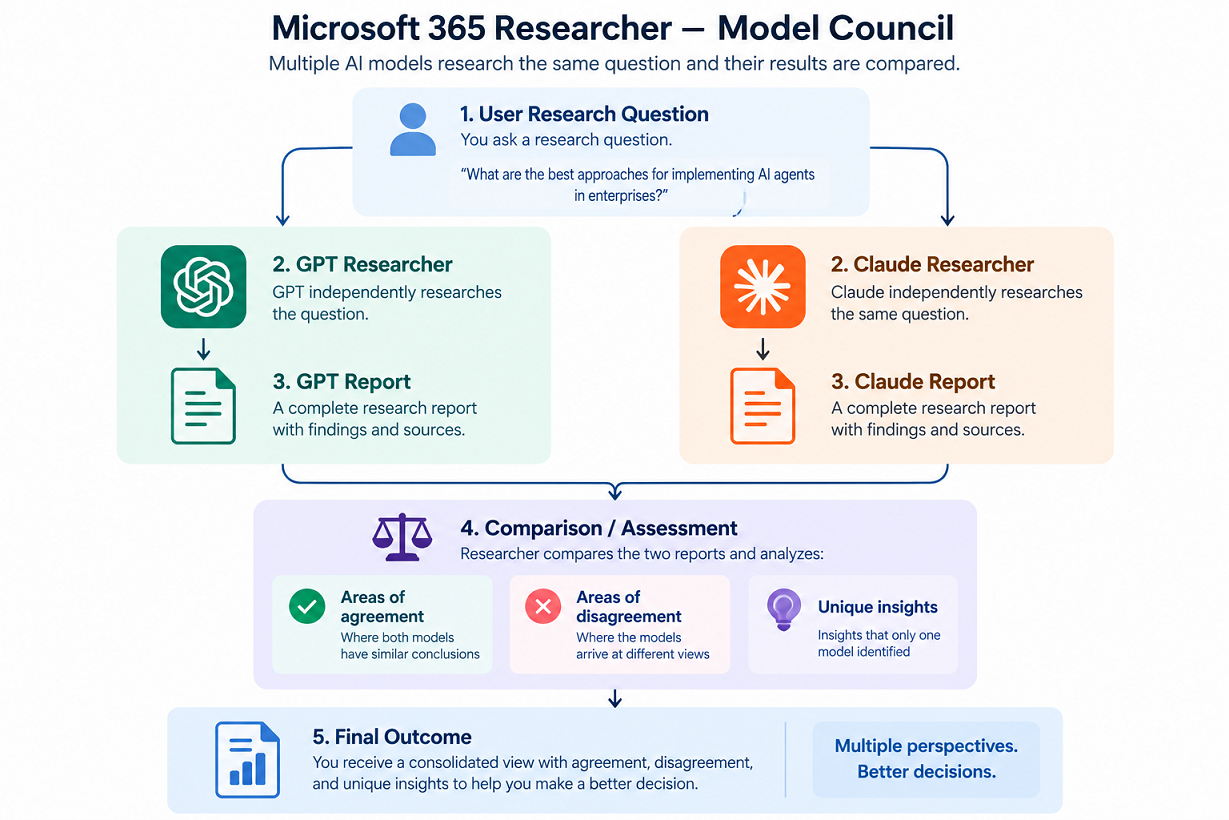
The key word here is independently.
Each model creates its own standalone research report rather than seeing the other model’s report first and simply commenting on it. Researcher then provides an analysis showing how those reports compare.
What Does Council Show?
1. Where the Models Agree
Suppose both models independently conclude:
Data governance and identity controls should be established before deploying enterprise AI agents at scale.
Agreement doesn’t automatically make a statement correct.
However, independent convergence can give the user another useful signal that the conclusion deserves attention.
2. Where the Models Disagree
This is potentially even more valuable.
Imagine researching:
Should our organization build AI agents using low-code platforms or custom development?
One model might lean toward starting with Copilot Studio because it reduces development complexity and integrates naturally with Microsoft 365. Another might conclude that for complex enterprise orchestration and highly customized AI workflows, a custom solution using Microsoft Foundry provides greater architectural flexibility. Neither perspective necessarily has to be wrong. They may simply emphasize different assumptions. Council makes those differences visible rather than silently selecting one answer.
3. Unique Insights
One model may discover or emphasize something that the other doesn’t.
For example, the GPT report may provide stronger analysis around enterprise architecture, integrations, and governance, while the Claude report may identify organizational adoption risks or provide a different interpretation of the available evidence.
Council can highlight these unique contributions. That is extremely useful when researching subjects without a single obvious answer.
Example: Model Council for an AI Strategy Decision
Consider an organization evaluating this question:
Should we develop our own enterprise AI platform or primarily adopt Microsoft 365 Copilot and Copilot Studio?
This isn’t purely a factual question.
There are many dimensions:
- Cost
- Development effort
- Security
- Data access
- Governance
- Customization
- User adoption
- Microsoft 365 integration
- Existing development skills
- Long-term maintenance
- AI model flexibility
- Time to market
This is an excellent Council question.
You could prompt Researcher:
Research whether a large enterprise already using Microsoft 365 should build a custom enterprise AI platform using Microsoft Foundry or prioritize Microsoft 365 Copilot and Copilot Studio. Evaluate architecture, security, governance, customization, cost, time to market, maintenance, extensibility, user adoption, and long-term strategy. Provide recommendations for different organizational scenarios.
Council could produce a GPT research report, a Claude research report, and a Council analysis highlighting areas of agreement, disagreement, and unique observations.
Instead of receiving one AI recommendation, the decision maker receives something closer to a mini advisory panel.
Another Council Example: Emerging Technology
Council becomes especially useful when researching a rapidly developing subject.
For example:
Research how Agent-to-Agent protocols, MCP, enterprise AI agents, and multi-agent orchestration are likely to change enterprise application architecture over the next three years. Identify opportunities, architectural risks, security challenges, and areas where the technology is still immature.
There isn’t necessarily one universally accepted answer. Different models may interpret current developments differently, give different importance to emerging standards, identify different risks, make different assumptions about adoption, and reach different conclusions about maturity. In this case, disagreement itself becomes useful information.
Critique vs Model Council
| Feature / Option | Critique (Auto / Critique) | Model Council | GPT (Standalone) | Claude (Standalone) |
|---|---|---|---|---|
| Primary Goal | Improve one report | Compare independent research | Quick baseline research | Quick baseline research |
| Approach | Writer + reviewer | Multiple researchers + assessor | Single researcher | Single researcher |
| Models Involved | GPT drafts; Claude provides another reasoning/review pass | GPT and Claude research independently | GPT only | Claude only |
| Output | One improved report | Multiple reports + comparison | One standard report | One standard report |
| Focus | Quality & Refinement | Perspective & Variety | Efficiency | Efficiency |
| Useful for | Producing a final research document | Exploring uncertainty | Rapid exploration | Rapid exploration |
| Agreement Analysis | Not the primary purpose | Yes | N/A | N/A |
| Disagreement Analysis | Not the primary purpose | Yes | N/A | N/A |
| Unique Perspectives | Combined into the refinement process | Explicitly surfaced | Single perspective | Single perspective |
| Decision Support | Provides a refined recommendation | Provides competing perspectives | Single point of reference | Single point of reference |
| Best Mental Model | Peer review | Expert panel | Solo assistant | Solo assistant |
When Should You Use Which?
A useful rule is to ask yourself:
Do I want the best single report, or do I want to understand multiple possible interpretations?
Use Critique when:
You need a polished research report that you intend to consume or share as one consolidated result. You aren’t necessarily interested in seeing how GPT and Claude think differently. You primarily want Researcher to produce a strong final deliverable.
For example:
Analyze the competitive landscape for Microsoft Copilot Studio and prepare a detailed report.
Use Model Council when:
The research will influence an important decision and you want to understand alternative viewpoints. There may not be one objectively correct answer, and seeing where different research approaches agree or disagree is valuable.
For example:
Should we invest in building custom AI agents or standardize primarily on Microsoft 365 Copilot?
Practical Use Cases
| Scenario | Recommended Mode | Why |
|---|---|---|
| Competitive analysis | Critique | Produces a strong consolidated report |
| Technology comparison | Critique | Review can improve completeness |
| Regulatory research | Critique | Evidence and source quality are important |
| Executive research report | Critique | Usually requires one polished result |
| Architecture recommendation | Critique or Council | Depends on whether alternatives are ambiguous |
| Emerging technology research | Council | Different interpretations are valuable |
| Strategic investment decision | Council | Decision makers benefit from multiple perspectives |
| Build vs buy decision | Council | Assumptions can produce different conclusions |
| AI platform strategy | Council | Multiple valid approaches may exist |
| Market prediction | Council | Future outcomes involve substantial uncertainty |
A Useful Way to Think About Researcher
Traditional generative AI often works like this:
Ask → Generate → Answer
Critique changes that pattern to:
Ask → Research → Generate → Review → Improve → Answer
Council changes it further:
Ask → Research independently → Generate multiple reports → Compare → Explain differences → User decides
This represents an important evolution in enterprise AI. The objective isn’t simply to make the AI produce more text. The objective is to introduce checks, alternative reasoning paths, and structured comparison into the research process.
What Value Do Users Get from Critique and Council?
The biggest improvement isn’t simply that Researcher now has access to more AI models.
The more important change is how those models are used together.
With Critique, users get a form of built-in quality review.
Instead of:
AI creates research → User receives it
the workflow becomes:
AI creates research → Another AI reviews it → Research is improved → User receives it
With Council, users get diversity of reasoning.
Instead of:
Ask one AI → Receive one interpretation
the workflow becomes:
Ask multiple AI researchers → Compare their findings → Understand agreement and disagreement → Make a better-informed decision
For everyday research, Critique will often be the natural choice because most users ultimately need one reliable, structured report. For strategic, ambiguous, or high-impact questions, Model Council becomes particularly powerful because disagreement can be as valuable as agreement. The real benefit is therefore not simply GPT + Claude.
It is the introduction of different roles into AI-assisted research:
Researcher → Reviewer → Independent Researcher → Assessor → Human Decision Maker
The human still makes the final judgment, but Researcher can provide a much richer evidence base on which to make that judgment.
Summary
Microsoft 365 Researcher is evolving from a deep-research agent into a multi-model research system.
Critique follows a writer-and-reviewer approach. GPT generates the research and Claude provides another reasoning pass designed to strengthen the final report. It is best when users want one comprehensive and trustworthy research deliverable.
Model Council follows an independent-experts approach. Multiple models investigate the same problem separately, and Researcher then identifies agreement, disagreement, and unique insights. It is particularly valuable for strategy, emerging technologies, architecture decisions, and other questions where several defensible answers may exist.
A simple decision rule captures the difference:
Need one stronger answer? Use Critique.
Need to understand different possible answers? Use Model Council.
Together, these capabilities move AI-assisted research beyond simply asking a powerful model a difficult question. They introduce review, comparison, alternative reasoning, and greater human visibility into how conclusions are reached.
Leave a comment