
Microsoft Build 2026: How Microsoft Foundry Is Powering the Next Generation of AI Agents
Introduction
Microsoft Build 2026 showcased a major evolution in Microsoft’s AI strategy. While previous years focused on copilots and generative AI experiences, Build 2026 demonstrated how AI is rapidly moving toward intelligent, autonomous, and collaborative agent systems.
At the center of this transformation is Microsoft Foundry, Microsoft’s unified platform for building, deploying, managing, and governing AI applications and agents at enterprise scale.
The theme emerging from Build 2026 is clear: the future belongs to developers who can combine models, data, tools, memory, and governance into production-ready AI systems.
Hosted Agents Simplify Enterprise AI Deployment
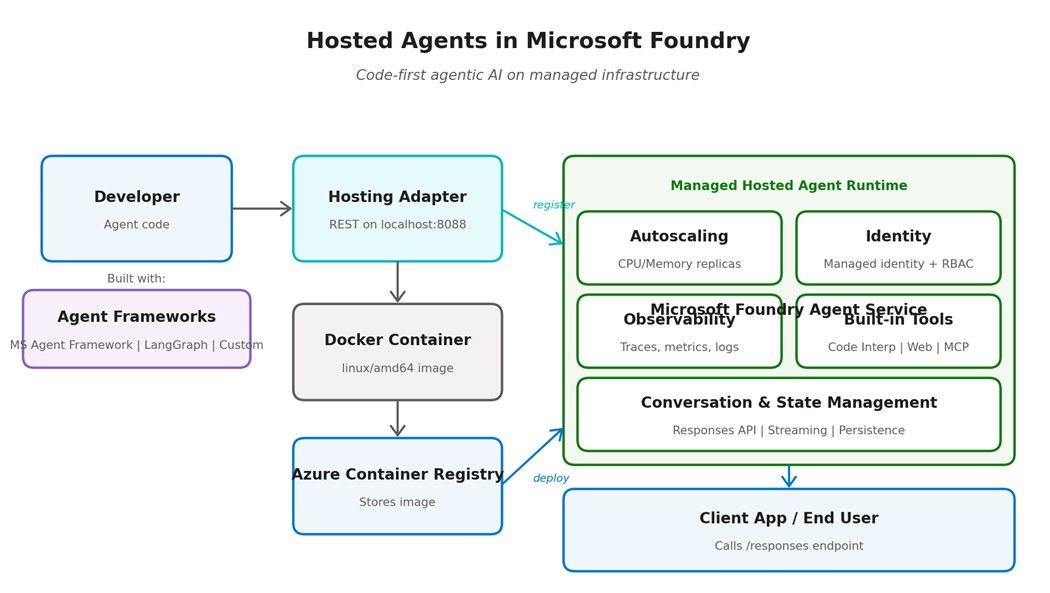
A major challenge for organizations adopting AI agents is operational complexity. Build 2026 introduced significant advancements in Hosted Agents within Microsoft Foundry Agent Service.
Hosted Agents enable organizations to:
- Deploy agents without managing infrastructure
- Scale automatically
- Support long-running workflows
- Maintain enterprise-grade security
- Simplify lifecycle management
Microsoft’s goal is to allow developers to focus on business capabilities rather than infrastructure management.
For enterprises building customer service agents, HR assistants, IT support agents, or operational automation solutions, this dramatically accelerates time to value.
New Agent Capabilities: Memory, Skills, and Runtime Intelligence
One of the most exciting areas of innovation announced at Build 2026 is the expansion of agent capabilities. Microsoft Foundry now introduces several foundational building blocks for more intelligent agents.
Procedural Memory
Agents can now retain learned processes and operational context over time.
This allows agents to:
- Remember previous workflows
- Improve consistency
- Support long-running business processes
- Deliver more personalized experiences
Rather than treating every interaction as a new conversation, agents can build upon previous experiences.
Skills and Toolboxes
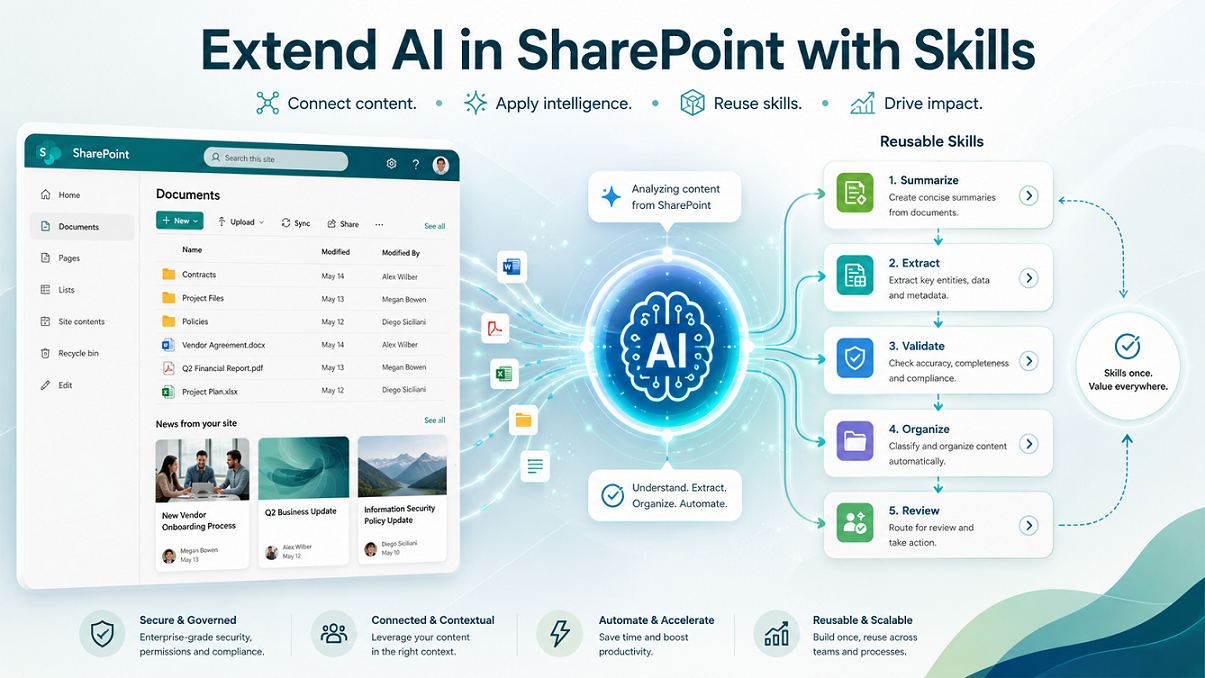
Microsoft announced enhanced support for Skills and Toolboxes. Skills allow organizations to package reusable business capabilities that can be shared across multiple agents.
Examples include:
- Customer lookup
- Document processing
- Approval workflows
- Inventory checks
- ERP integrations
Toolboxes provide standardized collections of tools that agents can use securely and consistently. This promotes reusability and reduces development effort across large organizations.
Foundry IQ Advances Enterprise Grounding
Grounding remains one of the most important requirements for enterprise AI. At Build 2026, Microsoft highlighted continued innovation in Foundry IQ, helping organizations connect AI systems to trusted business data.
Enhancements include:
- Smarter content extraction
- Improved data pipelines
- Better retrieval quality
- Enhanced security controls
- Governance improvements
Microsoft also reported significant improvements in agentic retrieval quality, helping AI systems produce more accurate and relevant responses. For enterprises, this means AI agents can make decisions and generate responses using authoritative organizational knowledge instead of relying solely on model training data.
Model Choice Continues to Expand
A recurring theme throughout Build 2026 was model flexibility. Microsoft is investing heavily in a multi-model ecosystem that allows organizations to select the best model for each workload.
Microsoft Foundry now supports a broad collection of:
- Microsoft AI models
- Partner models
- Open-source models
- Custom fine-tuned models
- Multimodal models
This approach gives organizations the freedom to optimize for:
- Cost
- Performance
- Latency
- Compliance
- Industry-specific requirements
Rather than locking customers into a single AI provider, Microsoft is positioning Foundry as an open platform for model innovation.
Microsoft’s New MAI Models Expand the Foundry Ecosystem
Microsoft Build 2026 also introduced significant advancements to Microsoft’s in-house MAI (Microsoft AI) model family, demonstrating the company’s continued investment in building world-class AI models optimized for enterprise and developer workloads. Available through Microsoft Foundry, these models are designed to support reasoning, coding, image generation, speech, and transcription scenarios while giving organizations greater flexibility in choosing the right model for their AI applications. By expanding the MAI portfolio, Microsoft is strengthening its open and multi-model strategy, enabling customers to balance performance, cost, governance, and workload-specific requirements across a unified AI platform.
Key MAI model announcements include:
- MAI-Thinking-1 – Microsoft’s flagship reasoning model, designed for complex problem-solving, multi-step reasoning, software engineering tasks, and long-context understanding.
- MAI-Code-1 Flash – A lightweight, high-performance coding model optimized for developer productivity and integrated into tools such as GitHub Copilot and Visual Studio Code.
- MAI-Image-2.5 – Supports advanced image generation and image editing capabilities for creative and business applications.
- MAI-Image-2.5 Flash – A faster and more cost-efficient image model designed for real-time visual AI experiences.
- MAI-Voice-2 – Delivers natural, multilingual speech synthesis with improved voice quality and broader language support.
- MAI-Transcribe-1.5 – Provides high-accuracy speech-to-text transcription for meeting intelligence, contact centers, and enterprise communication scenarios.
- Microsoft Foundry Integration – All MAI models are available through Microsoft Foundry, allowing developers to easily incorporate them into AI applications and agentic workflows.
- Greater Model Choice – The MAI family complements Microsoft’s growing ecosystem of proprietary, partner, and open-source models, giving organizations more flexibility when selecting AI capabilities for specific business needs.
Together, these new MAI models demonstrate Microsoft’s commitment to delivering a comprehensive AI platform that supports a wide range of multimodal and agentic AI scenarios while maintaining enterprise-grade scalability, security, and governance.
Stronger Observability and Governance
As AI systems become more autonomous, governance becomes increasingly important.
Microsoft Foundry now includes expanded capabilities for:
- Agent monitoring
- Tracing
- Evaluation
- Diagnostics
- Operational insights
- Compliance controls
These capabilities help organizations understand:
- What agents are doing?
- Why decisions were made?
- Which tools were used?
- How workflows are performing?
This level of visibility is critical for regulated industries and enterprise-scale deployments.
From Laptop to Cloud: A Unified AI Platform
A key message from Microsoft’s Build 2026 keynote was the creation of a seamless AI development ecosystem spanning devices, edge environments, and cloud infrastructure.
Microsoft described a future where developers can build AI solutions that operate across:
- Local devices
- Enterprise environments
- Cloud infrastructure
- Multi-model ecosystems
All while maintaining control, governance, and flexibility.
This vision aligns closely with Microsoft’s broader strategy of making AI accessible everywhere while keeping developers at the center of innovation.
Conclusion
Microsoft Build 2026 demonstrated that the industry is moving beyond simple chat experiences toward intelligent, action-oriented AI systems.
Microsoft Foundry is emerging as the platform that enables this transformation by bringing together models, memory, tools, runtime services, grounding, observability, and governance into a unified development experience.
Leave a comment