
Implementing Multi-Agent Systems with Microsoft Foundry
Introduction
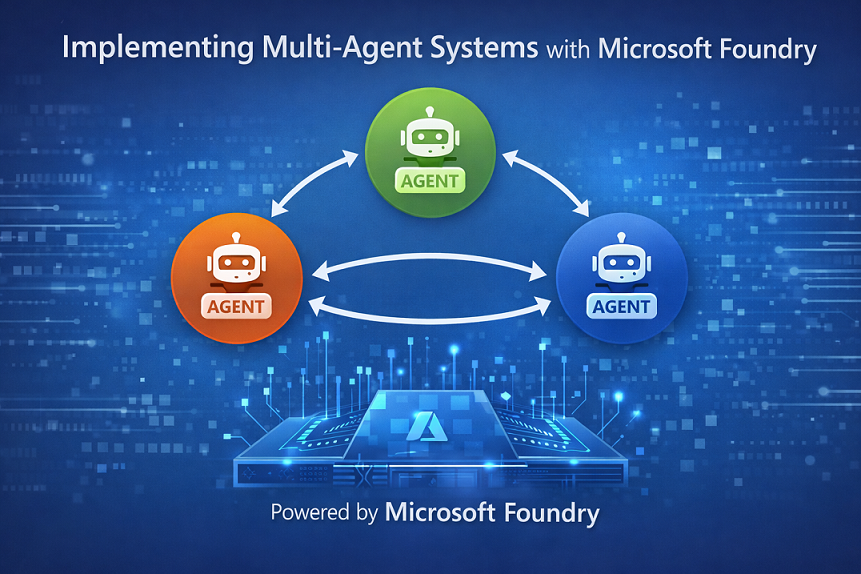
Artificial Intelligence is moving from single chatbot experiences to multi-agent systems, where multiple intelligent agents collaborate to solve complex business problems. Instead of one large model handling everything, different agents specialize in tasks like planning, data retrieval, validation, summarization, or compliance checks.
Microsoft Foundry provides a structured environment to design, build, deploy, and govern such multi-agent solutions. It offers model access, orchestration, evaluation, observability, and enterprise-grade security.
This article explores how multi-agent systems are implemented using Microsoft Foundry, the architectural patterns involved, governance implications, and a real-world example of intelligent orchestration in action.
Designing Coordinated AI Workforces for the Enterprise
Artificial intelligence in the enterprise has rapidly evolved from experimental chatbots to mission-critical systems embedded in operational workflows. Early implementations typically relied on a single large language model responding to prompts in isolation. While this approach works for simple Q&A scenarios, it begins to fail when organizations attempt to automate complex reasoning, decision-making, classification, and cross-system orchestration.
Enter the multi-agent paradigm
Rather than depending on one monolithic AI model to do everything, multi-agent systems decompose intelligence into specialized agents that collaborate toward a shared outcome. Microsoft Foundry provides the architectural foundation to design, orchestrate, govern, and scale such systems responsibly within enterprise boundaries.
The Shift from Single AI to Coordinated Intelligence
Traditional AI chatbot implementations often struggle with reliability, explainability, and control. As prompt complexity grows, responses become harder to debug. Costs increase as larger models are repeatedly invoked for tasks that do not require advanced reasoning. Governance becomes difficult because there is no structured breakdown of responsibility.
Multi-agent systems address these limitations by introducing specialization. Instead of one AI handling classification, routing, estimation, compliance, and summarization simultaneously, the workload is distributed across purpose-built agents.
This mirrors how organizations operate in reality. In a company, different departments handle specific responsibilities — finance manages budgets, legal ensures compliance, operations handle execution. Multi-agent systems apply the same principle to artificial intelligence.
Microsoft Foundry enables this structured, collaborative model by providing not only model hosting capabilities but also orchestration mechanisms, knowledge integration, identity enforcement, and observability.
Understanding the Multi-Agent Architecture in Foundry
At its core, a multi-agent system implemented in Microsoft Foundry consists of four foundational layers:
- Specialized Agents
- An Orchestrator
- Shared Context or Memory
- Governance and Observability Controls
Each component plays a defined role in the system.
Specialized Agents
Every agent in the system is designed with a single responsibility. One agent might evaluate urgency. Another may assign ownership. A third might estimate effort. These agents are defined using carefully engineered prompts, structured output schemas, optional tool integrations, and guardrails.
The critical principle here is determinism. In enterprise settings, agents must produce structured, machine-readable outputs — typically JSON schemas — so downstream orchestration remains reliable.
In Microsoft Foundry, agents can be configured to:
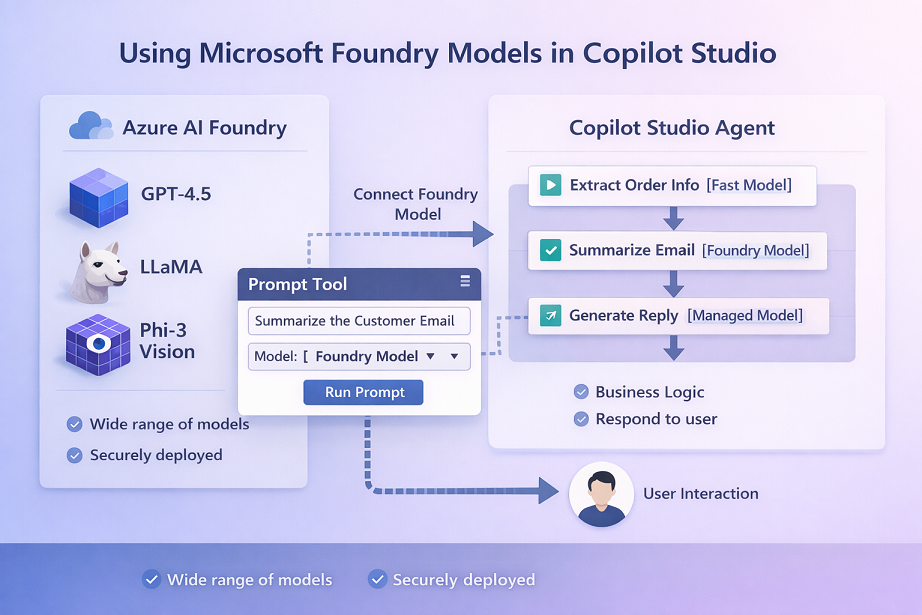
- Use different models depending on task complexity
- Access specific knowledge areas
- Call tools or APIs
- Enforce output validation rules
- Operate under identity constraints
This modularity enables independent tuning and governance of each agent.
The Orchestrator
The orchestrator is not another “super AI.” It does not attempt to solve the business problem itself. Instead, it coordinates the collaboration between agents.
When a request is received, the orchestrator determines:
- Which agents must be invoked
- Whether calls should be sequential or parallel
- How intermediate results should be aggregated
- Whether conditional routing is required
- What final structure should be returned
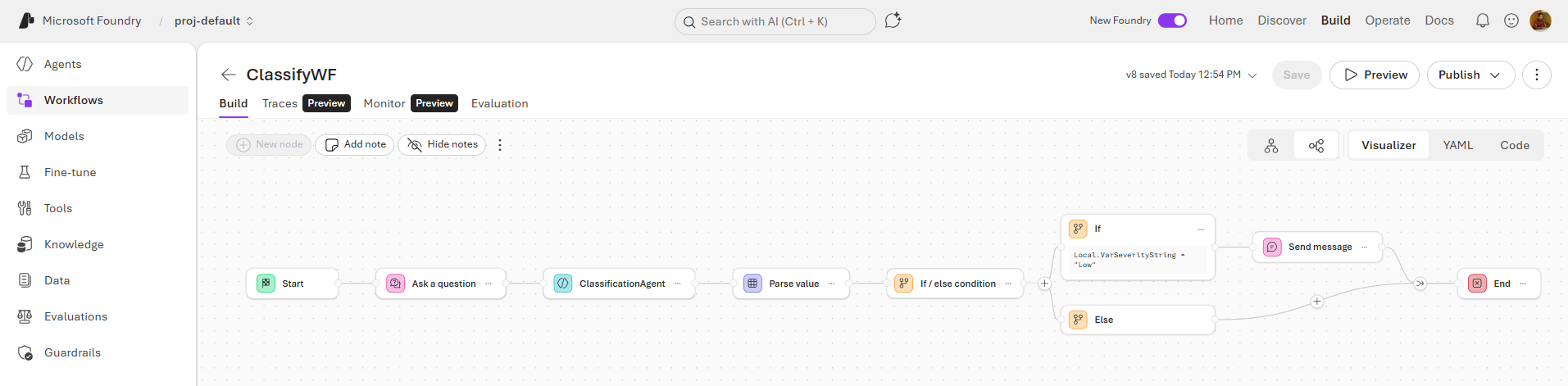
In Microsoft Foundry, orchestration logic can be implemented using workflow definitions, conditional routing logic, or agent chaining patterns.
Shared Memory and Context Management
For agents to collaborate effectively, they must operate within a shared context. This may include:
- Original user input
- Intermediate structured outputs
- Retrieved knowledge from indexed data
- Session-level state information
Foundry allows structured context injection and secure retrieval from knowledge stores, ensuring that agents operate with the right information while respecting data boundaries.
Governance and Observability
Enterprise AI cannot function as a black box. Every interaction must be traceable, auditable, and compliant.
Microsoft Foundry integrates:
- Prompt and response logging
- Guardrail enforcement
- Identity management
- Model usage tracking
- Cost monitoring
- Access control policies
This transforms multi-agent systems from experimental prototypes into production-ready enterprise infrastructure.
A Practical Example: Implementing a Bug Triage Multi-Agent System
To illustrate how multi-agent systems operate in practice, consider a software organization attempting to automate its bug triage process.
When a new ticket arrives, the organization needs to determine:
- How urgent the issue is
- Which team should handle it
- How much effort it will require
Instead of building one large prompt attempting to answer all three questions simultaneously, the organization defines three independent agents:
Priority Agent
Analyzes ticket description and assigns a severity level.
Team Agent
Determines ownership based on domain keywords and context.
Effort Agent
Estimates implementation complexity and expected resolution time.
When a ticket such as:
“The checkout page crashes when selecting PayPal on mobile Safari.”
is submitted, the orchestrator sends the description to each agent. These agents may run in parallel because their analyses are independent.
Each agent returns a structured output:
- Priority: High
- Team: Frontend Payments Team
- Effort: Medium (Estimated 3 days)
The orchestrator aggregates these structured responses into a final JSON payload suitable for automation workflows, dashboards, or ticketing systems.
This modular architecture improves:
- Debuggability (each agent can be evaluated separately)
- Cost efficiency (lighter models can handle simpler classification tasks)
- Governance (each agent operates within defined boundaries)
- Maintainability (agents can be upgraded independently)
Orchestration Patterns in Microsoft Foundry
Multi-agent systems are not limited to simple parallel calls. Foundry supports several orchestration patterns depending on business requirements.
Sequential orchestration is useful when later agents depend on earlier outputs. For example, escalation logic may only execute if a priority agent returns “Critical.”
Parallel orchestration improves performance when tasks are independent.
Conditional routing enables policy-based flows, such as invoking a compliance agent only when certain keywords are detected.
Hierarchical orchestration allows a supervisory agent to delegate subtasks to specialized sub-agents, particularly in research-heavy or multi-step reasoning scenarios.
Selecting the appropriate pattern is a design decision driven by latency requirements, cost considerations, and business complexity.
Governance Considerations in Multi-Agent Deployments
As multi-agent systems become more autonomous, governance becomes increasingly important.
Organizations must answer critical questions:
- Which model was used for each agent?
- Was sensitive data accessed?
- Were guardrails triggered?
- How much did this interaction cost?
- Was policy routing applied correctly?
Microsoft Foundry provides mechanisms to monitor model selection, enforce token limits, isolate agent permissions, and apply identity-based access control using enterprise identity systems.
Without governance, multi-agent systems risk becoming fragmented AI silos. With governance, they become accountable digital workforces.
Cost Optimization in Multi-Agent Architectures
A common misconception is that multi-agent systems are inherently expensive. In reality, they often reduce cost when designed correctly.
Instead of invoking a high-capacity model for every task, Foundry allows:
- Lightweight models for classification
- Medium-tier models for structured reasoning
- Premium models for deep analysis only when required
Model routing policies can dynamically select models based on complexity thresholds. This ensures intelligent cost-performance balancing across the system.
Caching, token budgeting, and context trimming further optimize operational expenditure.
Debugging and Reliability
Multi-agent systems introduce new debugging challenges. Agents may disagree. Outputs may drift. Orchestrators may misroute.
To address this, production systems should:
- Log intermediate agent outputs
- Validate structured responses
- Implement maximum iteration limits
- Define fallback mechanisms
- Monitor confidence signals
Foundry’s observability framework makes it possible to trace the entire lifecycle of a multi-agent interaction, enabling iterative refinement and system hardening.
Multi-Agent Systems vs Traditional Workflow Automation
It is important to distinguish multi-agent systems from conventional workflow automation tools.
Traditional workflows are deterministic. They follow predefined rule trees. They do not reason — they execute logic.
Multi-agent systems introduce probabilistic reasoning, contextual interpretation, and adaptive behavior. They are not replacements for workflows but rather intelligent layers embedded within them.
In practice, enterprises often combine both:
- Workflows handle structured execution.
- Agents handle reasoning and interpretation.
Production Readiness and Strategic Adoption
Before deploying multi-agent systems in enterprise environments, organizations should validate:
- Structured output enforcement
- Guardrail definitions
- Logging and observability configuration
- Identity isolation
- Cost monitoring
- Fallback strategies
- Data classification policies
Multi-agent systems represent not just a technical shift but an operational shift. They introduce digital collaborators capable of reasoning within defined boundaries.
The Road Ahead
As Microsoft continues to enhance Foundry with agent identity, cross-agent communication, advanced orchestration frameworks, and observability enhancements, multi-agent architectures will mature into fully managed digital ecosystems.
Future systems may include:
- Agent marketplaces
- Enterprise memory graphs
- Self-optimizing routing
- Human-in-the-loop validation layers
- Federated agent collaboration
The transformation from chatbot implementations to coordinated AI workforces has already begun.
Conclusion
Implementing multi-agent systems with Microsoft Foundry allows organizations to build AI architectures that are modular, governed, cost-optimized, and production-ready.
Instead of relying on a single generalized intelligence, enterprises can design coordinated networks of specialized agents — each accountable, observable, and secure.
This approach moves AI from experimentation into enterprise-grade system engineering.
The future of enterprise AI is not a single model.
It is a structured ecosystem of intelligent agents working together under governance — and Microsoft Foundry provides the architectural foundation to build it.
Leave a comment